| |
| Post Contender: Oscar-Nominated Chris Tellefsen on Cutting "Moneyball" |
|
 Cutting "Moneyball" this past year for director Bennett Miller was a different experience in many ways for editor Chris Tellefsen (pictured left), ACE, from their previous collaboration together—2005's "Capote"—but in one crucial area, the experience was similar. Cutting "Moneyball" this past year for director Bennett Miller was a different experience in many ways for editor Chris Tellefsen (pictured left), ACE, from their previous collaboration together—2005's "Capote"—but in one crucial area, the experience was similar.
"Because both 'Moneyball' and 'Capote' were essentially portraits, there was an aesthetic link between them," Tellefsen says. "Getting under the skin of the characters through performance was key to the whole thing with Brad Pitt's Billy Beane, just as it was with Philip Seymour Hoffman's Truman Capote. It's a matter of vetting the footage, trying to get the most essential truth out of the characters, and drawing out a clear expression of that truth. The editing process is really about discovering the core of it, and the most natural rhythms of it."
Tellefsen's work on the film has earned him great recognition this awards' season — he received Academy Award and ACE Eddie nominations in recent days for his efforts. . The project posed numerous challenges, such as weaving archival Major League Baseball footage into sequences in a stylized way, building unique graphics to represent the Sabermetrics form of analyzing baseball statistics used by the movie's protagonist, Billy Beane, and reams of footage to cull through, among other things.
Still, from Tellefsen's point of view, the film's editing work was successful because of the commitment filmmakers shared in pursuing the best pieces of performance they could possibly find, and letting those performances, and not slick editing techniques, move to the forefront. For instance, he says that Miller and cinematographer Wally Pfister, ASC, used a documentary style camera for the movie's scout scenes in order to make almost what he calls "a mini movie" involving each of the baseball scout characters. "We had a lot to find, a lot to mine, to discover, and play with," he adds.
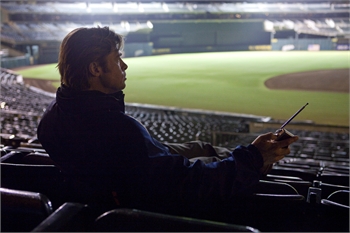 Indeed, Tellefsen emphasizes that many of the baseball scouts in the film were, in fact, real-life baseball men, not actors. This created "a veracity, a truth" in the performances that Tellefsen says he was able to mine during the cutting process. On the other hand, those pieces of "Moneyball" also tested his craftsmanship, because as one would expect with non-actors, the quality and energy of performances varied wildly. Indeed, Tellefsen emphasizes that many of the baseball scouts in the film were, in fact, real-life baseball men, not actors. This created "a veracity, a truth" in the performances that Tellefsen says he was able to mine during the cutting process. On the other hand, those pieces of "Moneyball" also tested his craftsmanship, because as one would expect with non-actors, the quality and energy of performances varied wildly.
"There were lots of takes, lots of angles, and multiple cameras," he says of those shots. "(With non-actors), it's just a matter of editing it rhythmically, to get them to be on the same plane with the actors. There is a different vibe between non-actors and actors on the screen. Some people are natural performers but are not actors, and some are not natural performers, but have a great presence. So it's my work to massage it to the point where everything feels integrated and right.
"After all, performance is everything. I cut for performance. That is my process—to bring those performances to their ultimate, to make them spectacular. (The actors give him) all this brilliant material, but you have to bring it into play, within the whole—every aspect, every flinch, every response, every reaction, every twitch, every movement."
Along the way, Tellefsen says he benefitted greatly from numerous test screenings that helped him shape and hone the course of the narrative. He calls that process "essential" in order "to get a feel" of how real human beings might react to the evolving nature of the cut. CLICK HERE to hear him explain some of the changes that came to the film resulting from input filmmakers received during the test screening process.
Tellefsen credits first assistant Debbie Tennant, second assistant Bart Rachmil, apprentice editor Mat Greenleaf, and PA Hasani Franke for allowing him to focus on "pure aesthetics" during the cutting process, saying they kept the "Moneyball" workflow seamless and simple while he cut at the project's editorial offices on the Sony lot in Culver City. The production utilized four Avid Nitris systems (v. 4.0.5) and 13TB of Unity storage. Technicolor Hollywood telecined and digitized dailies, sending them to editorial on hard drives, where assistants copied and organized them for Tellefsen.
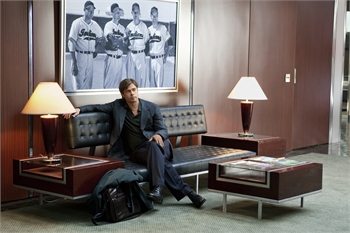 "The wrench in the system was all the archival baseball footage," first assistant Debbie Tennant adds. "They were provided to us on Beta SP tapes, and while cutting the baseball sequences, (Tellefsen) would ask for specific plays, teams, players, and lines from baseball announcers. (Assistants) would go through all the tapes, searching for specific plays, players walking or stealing, and lines from announcers to back up what the actors were saying. The baseball sequences were ever-changing as they were finding a structure (as they went along), so we spent hours combing through all the footage, digitizing it in the Avid, and organizing it." "The wrench in the system was all the archival baseball footage," first assistant Debbie Tennant adds. "They were provided to us on Beta SP tapes, and while cutting the baseball sequences, (Tellefsen) would ask for specific plays, teams, players, and lines from baseball announcers. (Assistants) would go through all the tapes, searching for specific plays, players walking or stealing, and lines from announcers to back up what the actors were saying. The baseball sequences were ever-changing as they were finding a structure (as they went along), so we spent hours combing through all the footage, digitizing it in the Avid, and organizing it."
During production, Tellefsen largely built the main narrative by himself, making what he calls "initial, knee-jerk responses to the footage," and then sitting down about a week after principal photography wrapped to review the assembly with Miller. That began a process of using that initial cut as a raw foundation for what Tellefsen calls "the honing process" until they got to "the essence of things."
"It's really a wonderful process—it's about being able to really dig in and work the material like paint," he adds. "We had a really strong crew, and they really whipped it all together and made sure we were completely covered and organized properly. It was a real seamless flow of work."
For more of Tellefsen's comments about editing "Moneyball," CLICK HERE for his podcast interview conversation.
—By Michael Goldman
'Moneyball' Images –© 2011 Columbia TriStar Marketing Group, Inc. All rights reserved. |
| |
 |
| |
| Post Contenders: Iain Blair's Picks |
| |
|  In Post Magazine's January issue, contributor Iain Blair's discusses the work of many craftspeople he expected, heading into awards' season, might get serious Academy Award consideration this year. As the recent Oscar nominations revealed, several of his choices are, in fact, among the nominees. They include veteran director and previous winner Martin Scorsese, editors Thelma Schoonmaker, ACE, Angus Wall, ACE and Kirk Baxter, ACE; cinematographer Janusz Kaminski; and veterans Richard Hymns and Gary Rydstrom for sound editing. Check out the January issue of Post for a deeper look or find the article HERE Also, note that the subjects of the last two Post Contenders newsletters--visual effects' supervisor Rob Legato and and sound editor Lon Bender--also received Oscar nominations. If you haven't already done so, you can hear podcast interviews with them about their work on "Hugo" and "Drive" respectively. In Post Magazine's January issue, contributor Iain Blair's discusses the work of many craftspeople he expected, heading into awards' season, might get serious Academy Award consideration this year. As the recent Oscar nominations revealed, several of his choices are, in fact, among the nominees. They include veteran director and previous winner Martin Scorsese, editors Thelma Schoonmaker, ACE, Angus Wall, ACE and Kirk Baxter, ACE; cinematographer Janusz Kaminski; and veterans Richard Hymns and Gary Rydstrom for sound editing. Check out the January issue of Post for a deeper look or find the article HERE Also, note that the subjects of the last two Post Contenders newsletters--visual effects' supervisor Rob Legato and and sound editor Lon Bender--also received Oscar nominations. If you haven't already done so, you can hear podcast interviews with them about their work on "Hugo" and "Drive" respectively.
|
| |
|
|
|
|