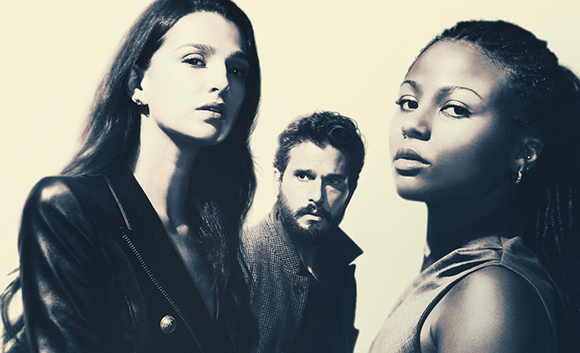
In HBO’s Industry, five young graduates do whatever it takes to make themselves indispensable at the London investment bank Pierpoint & Co. Season 4 recently concluded, with Harper (Myha’la Herrold) and Yasmin (Marisa Abela) drawn into a high-stakes, globetrotting game when a splashy fintech darling bursts onto the London scene.
Season 4 began airing weekly in early January and right away shook up the setting, with the Pierpoint gone, new characters introduced and more complex financial jargon mentioned. A further surprise comes via a ghost.
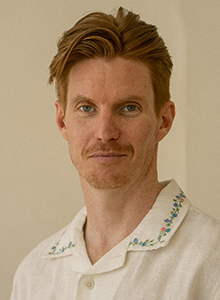
Kyle Traynor (pictured), who edited episodes of Seasons 2 and 3, returned to the show to edit the first and last two episodes, which were directed by the showrunners. He also became an associate producer on the season, as he was trusted to deliver a story arc that immersed the audience from the first to the last episode.
Here he shares how he adapted the editing style to the new story chapter this season and some of this season’s biggest challenges.
What were the differences between Season 4 after Season 3 and how did you adjust your editing approach?
“This year felt like a new series in many ways. The Pierpoint trade floor was always the centerpiece of the show, so with it gone and our characters scattered, we had to treat 401 almost like a pilot episode. We are introducing several new characters while trying to get everyone up to speed with what has happened in the world of Industry since the end of last season.
“My main approach was to take nothing for granted. While we definitely don’t overexplain things on Industry, we had to do the proper legwork in this episode to ground the audience in the wildly new set of circumstances our characters find themselves in. I often feel like what happens in a one or two-episode arc of Industry could be an entire season of another series. The episodes are jam-packed, so we needed to make sure we touch each of the storylines long enough that the viewer can acclimate. It took a lot of work to try and find the right balance but I think it makes for a really fun episode that moves.”
What was your editing setup and workflow like?
“Industry has always been cut on Avid. The show is based in the UK, and I have found most of the crew work on PCs, but I have always preferred a Mac setup, and they kindly obliged. I was based in LA during production, so I would wake up in the morning to a fresh new set of dailies and scene bins prepared for me. The assists were UK-based and would sync the footage to me while I was asleep. When I got in in the morning, we had a few hours before they signed off, so we would always have a touch base and handle any administrative stuff that was needed. Then I had the rest of the day to manage my time and cut scenes.
“Once I had a version of a scene I was happy with, I passed it back to the assists and they did a basic sound cleanup pass and placed any special SFX I had noted. Usually around lunch, I would review the sound work they had given back and either make changes or kick anything back to them that might need adjusting. Once I was happy with the SFX, it would go into the main assembly sequence, and the episode would slowly start to build out.
“Once shooting was complete, I flew to Cardiff and worked out of the BadWolf Studios, where the show is produced and shot. Several of the sets were located right below editorial, so some days we would go down and check out production. It’s a great setup because the showrunners or directors can be on-set and literally just walk up stairs to work with the editorial team.
“From Cardiff I would work with the showrunners Mickey (Down) and Konrad (Kay), who also directed the four episodes I cut this season, until everyone was happy with it.”
Did you use any additional tools or plug-ins?
“This isn’t a large VFX show, but we would have the occasional screen to comp, cleanup, or basic split screens that are needed. Some of those we could do in Avid for our offline, but if it ever needed anything additional, we would sub out to After Effects.
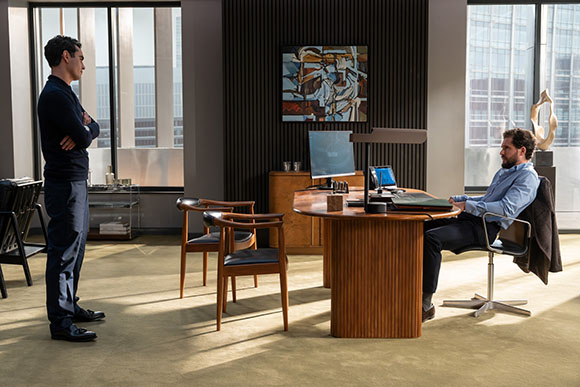
“I do a fair amount of splits, which can be tricky on a show with such intense camera movement. I had a shot in a boardroom in Episode 7, where we had the camera tracking in different directions, but I desperately wanted to split the performance from two different takes. Our assistant Rose Miller
was able to slow down the move on each shot, and you would never know they don’t technically match up.
“We also used a variety of Izotope audio plug-ins, usually for cleaning up rough production audio.”
You edited the first and last two episodes, and have an associate producer credit. What was your larger role in post production like and how did you collaborate with the other editors and showrunners?
“I have been really fortunate to work with a great team of editors on this series that believes in opening up the edit room to collaboration. I think it’s partly because Industry can be very dense and that collaboration is needed to track the story. But I also think it makes for a much better end product.
“For Season 4, our other editors, Simon Smith and Ben Mudge, were fantastic about sharing cuts and talking through the dense subplot that often exists in this show. We had scenes bouncing between episodes or needle drops that we were demoing on multiple scenes across blocks. We had to keep the room very fluid, so having great communication and open doors is, in my opinion, the best way to do that.
“My role as an AP came about fairly naturally from Season 3, where I also cut the first and last two episodes. When you are across half the season, you are going to be involved in so many important decisions that dictate the tenor of the show. I think Mickey and Konrad, along with the executives at BadWolf, recognized I really connected with the style of the show, and they were kind enough to trust me to help implement that style throughout all of post production.”
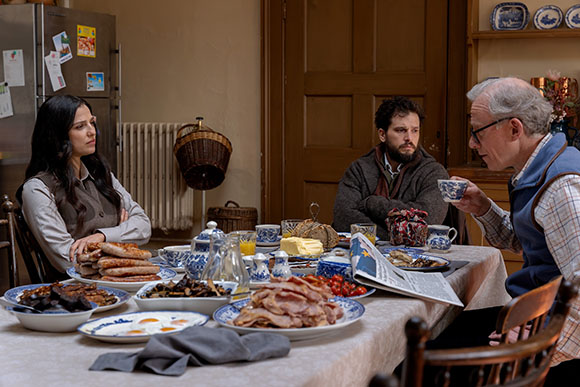
In Episode 2, you had to navigate introducing the supernatural into an extremely grounded show.
“Yeah, that was quite a shock when I read it in the script. Mickey and Konrad always write such rich characters, and this episode is almost exclusively a deep dive into the mind of Kit Harrington’s character, Henry Muck. We had never really done anything like that in the series and had to be extremely cautious to avoid anything that felt forced or trite. One thing we discussed early on was that this entire episode needed to feel different. We knew we wanted to play the reveal of the Commander fairly straight, so we had to tip the audience off ever so slightly throughout the episode that something was ‘off.’ This was done through a mixture of things. We hold on shots a little longer in several places, utilizing the zooms that were set up in Episode 1 even more. The music for the episodes deviates from our very contemporary synth score that our composer, Nathan Micay, usually does for the show. We needed to start tilting the world of Industry ever so slightly to let you know something is coming.
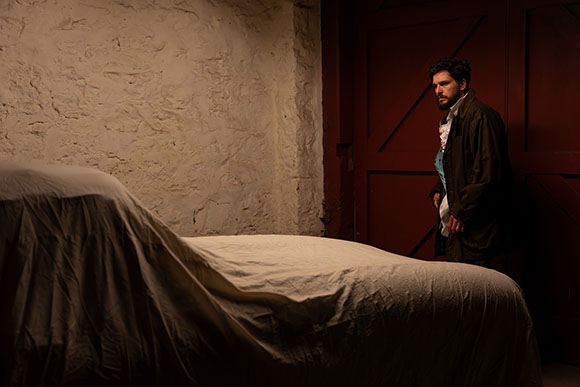
“For the reveal of the Commander, it was always scripted that the majority of the information you would gain about this person would be after they were gone. We could have made a version where, as he pulls down his turtleneck to reveal his bloodied neck, we as viewers see shots of Henry as a child and the Commander looking very much as we have seen him all episode.
“Instead, we don’t fully explain what’s happening. There is a clue as we tilt down to the Commander wearing the same watch that Henry receives at the beginning of the episode, but beyond that, the viewer is left in a kind of ‘WTF’ moment. Then we stay with Henry’s emotion as he stumbles back to the manor, into the garage, to take his own life. It’s only in this section that we get more information on the Commander. Henry is running back his last memories of his father, and we are revealing character information as Henry is feeling it.
“The ‘gotcha’ of the scene isn’t so much that the Commander isn’t real, it’s that Henry is being tortured by his past and falling into the very same steps that caused his father to take his own life. I think, overall, it makes for a much more effective sequence and hopefully keeps this from feeling less like a ghost story and more like the story of a man who is struggling with depression.”
What scenes would you point to as challenging or highlights from an editorial perspective?
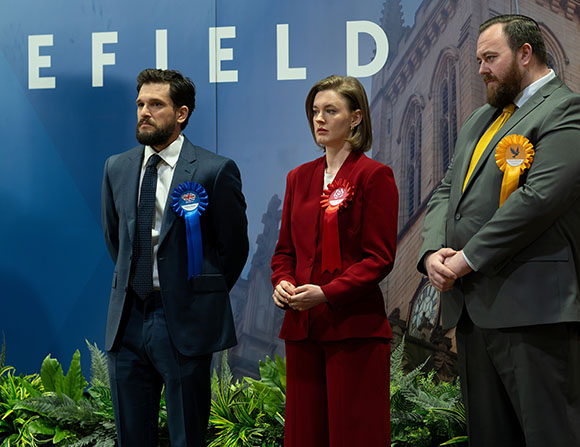
“I really enjoyed cutting the boardroom scene at the end of Episode 1, where Whitney double-crosses Jonah. They pretty much had a full day to shoot that scene, which is right in the middle of the Tender offices, so I had lots of coverage. What was important when entering that scene was that we were with Jonah. He doesn’t know what’s about to hit him.
“I used one of our Zoom cameras to bring him and Whitney into the room, and it pulls back slowly to reveal the entire board waiting for him. The frame shows an assembled team in the foreground and Jonah isolated, small in the back of the frame. After that, it was a really fun interplay of who to be on for which set of lines. I found myself staying with Whitney more as the scene goes on. Watching how Whiteny handles the moment of his best friend being destroyed by his very hand is much more interesting. There is a tiny beat where one of the board members is reading out the various complaints against Jonah and describing his ‘odor’ and lack of cleanliness. I found a great shot where Whitney wipes his pants as if to clean himself of this decision. Little touches like that combined with the wonderful use of our zooms, made that scene really fun to work on.
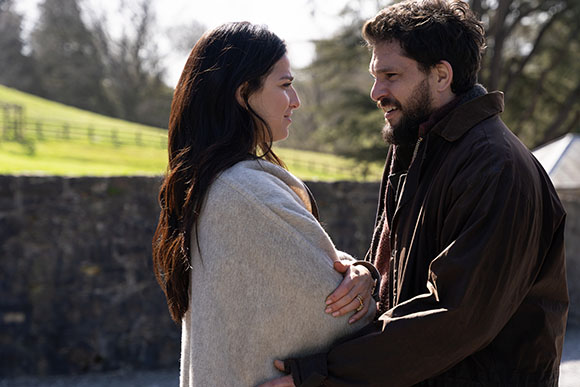
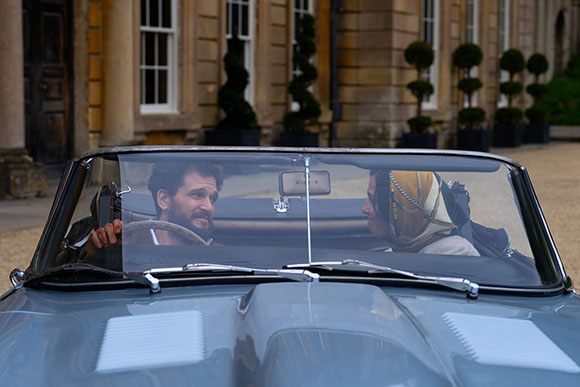
“Another fun one was near the end of Episode 2. We’ve been in high drama mode for almost 10 minutes as Henry meets his dead father, relives the worst moment of his childhood, and is inches from killing himself. Mickey and Konrad write the next scene to punctuate that entire sequence by having Henry drive around the front of the manor, screaming for Yasmin. She comes running out, and the two of them make love on the hood of the very same car he almost killed himself in. The majority of the scene is cut for pace and emotion, but as they start to make love, we move into a very high-angle POV push looking down on the car.
“Then, with one of my favorite cuts this season, we cut back to reveal it’s Lord Norton looking down on the two of them making love. The Andy Williams track ‘Can’t Take My Eyes Off of You’ kicks in, and we are forced to sit in the horribly awkward moment where Yasmin is trapped between these two powerful men. I use pushes on each of their POVs and hold the comedy/horror as long as I can before the tension breaks. It’s just such a wildly unserious moment in what has been a roller coaster of an episode. It really sums up the feel of Industry, and I laugh every time I watch it.”