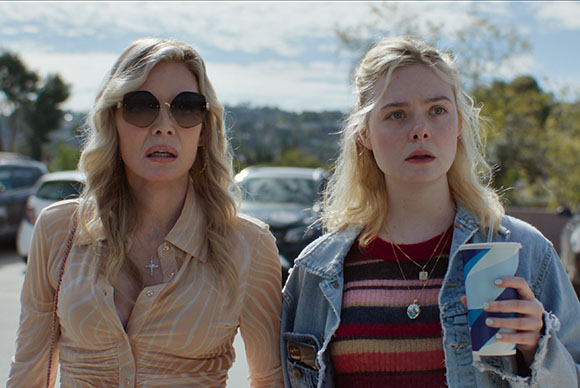
Apple TV’s Margo’s Got Money Troubles is a comedic family drama that follows recent college dropout and aspiring writer Margo (Elle Fanning), the daughter of an ex-Hooters waitress (Michelle Pfeiffer) and ex-pro wrestler (Nick Offerman), as she’s forced to make her way with a new baby and a mounting pile of bills. The series also stars Marcia Gay Harden, Greg Kinnear, Michael Angarano, Rico Nasty and Lindsey Normington. The show is based on Rufi Thorpe’s best-selling novel of the same name. Margo’s Got Money Troubles premiered on April 15th with three episodes. New episodes follow every Wednesday through May 20th.

Ciara Elwis is an Emmy-winning music supervisor and recently oversaw music for the show. Known for her work on HBO’s I May Destroy You, which earned her the 2021 Emmy Award for Outstanding Music Supervision, Ciara recently shared insight into her work on the eight-episode series.
Ciara, what were the music needs of Margo’s Got Money Troubles ?
“One of the most exciting creative challenges of this series was finding a musical language that could hold all its contradictions at once: intimate and anarchic, deeply rooted in family and wildly contemporary, poignant and defiantly alive. Rather than approaching the soundtrack as a collection of needle drops, we approached it as a family tree.
“I built three playlists from the outset, Margo’s world (Elle Fanning), Shyanne’s world (Michelle Pfeiffer), and Jinx’s world (Nick Offerman), mapping not just character taste, but character DNA. The connective tissue between Juice Newton and King Princess, between Sheena Easton and Clairo, is not just tonal but thematic. At their core, these songs are about desire, resilience and the refusal to apologize for who you are. The throughline is Margo.
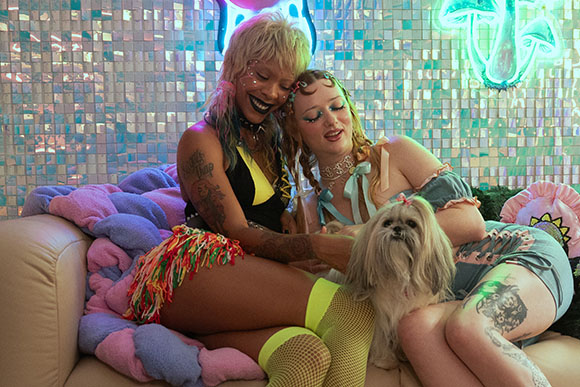
“The music also needed to reflect a specific storytelling device from the novel that the series continues: the shift between first and third person. Some tracks play from deep inside Margo’s subjective experience. Others observe her from the outside, the way the world sees her or the way she sometimes sees herself. Rico Nasty’s ‘iPhone’ and Princess Nokia’s ‘Drop Dead Gorgeous’ are emphatically third-person tracks, the Margo she is performing for the world. CMAT’s ‘Take a Sexy Picture of Me’ and St. Vincent’s ‘Big Time Nothing’ are first person, capturing the vulnerability and private questioning beneath the persona. The music holds both versions of her simultaneously.”

How many music cues did the series require?
“The series features over 80 needle drops across the eight episodes, spanning an extraordinarily broad musical range — from Dire Straits and Motley Crue to CMAT and Princess Nokia. Beyond the needle drops, the series also features a significant number of diegetic cast performances, including Michelle Pfeiffer covering Elvis’s ‘I Can’t Help Falling In Love With You,’ Elle Fanning performing Reba McEntire’s ‘Is There Life Out There?,’ Michelle Pfeiffer and Elle Fanning delivering an incredible rendition of ‘Angel of the Morning,’ Greg Kinnear and Michelle Pfeiffer duetting on ‘Let It Be Me,’ and an Elvis impersonator rendition of ‘Burning Love.’
“The density of music across the series reflects a very deliberate creative choice. Needle drops are woven into the fabric of every episode as a narrative and character device, tracking Margo’s emotional journey, seeding the influence of her parents’ worlds and bridging the multigenerational story with the very online contemporary world she discovers.”
How did budget come into play?
“Budget is always part of the creative conversation, and this series was no exception. The most direct example is ‘Rebel Yell.’ The track that was originally scripted ended up being more expensive than we’d anticipated, and whilst an excellent song, we knew that, given the scale of our music aspirations for the series, we needed to make smart choices to ensure the budget worked for us. I pitched ‘Rebel Yell’ as an alternative, and I’m so glad that’s where we landed.
“’Rebel Yell’ has something the original song did not — a deep undercurrent of yearning and the sense of a soul wanting to be set free, which works so perfectly for this moment of unity between Shyanne and Margo. It is bold, jagged and real. Just like them. It is a good reminder that sometimes having to stop and re-think can take you somewhere even better than where you started.”

Can you talk about some of the tracks that helped shape certain scenes?
“Two of the music choices in Episode 5 were essential in mirroring the highs and lows of the episode. ‘Angel of the Morning’ by Juice Newton was transformative for the opening drive to Vegas at the start of Episode 5. We explored several options and versions of the song, but Juice Newton’s recording kept asserting itself was the version that felt most true to Shyanne, the one she would have loved and known by heart.
“We shot the performance live on the day, which was a big creative risk, but one that paid off completely thanks to Michelle and Elle’s incredible performances. The song works so perfectly for this scene because of what it says about the women at the heart of this series. It is a song about taking love entirely on your own terms, without shame or apology, regardless of what the world thinks of your choices. That is Shyanne and Margo both: two women one generation apart, both navigating a world that has consistently asked them to make themselves smaller, and both refusing.
It also speaks directly to one of the series’ core themes: the complicated, layered relationship between mothers and daughters, and the way love and identity pass between generations, whether we intend them to or not. Margo’s musical taste has been shaped by her parents, and this moment makes that visible and audible simultaneously.
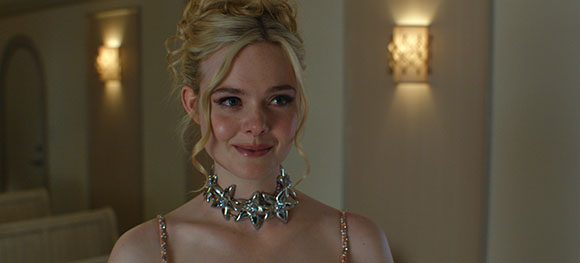
“’I Lied’ by Lord Huron is the emotional hinge of the entire episode. A lilting ballad about the deep confliction found in regretting past mistakes whilst finding quiet relief in being honest, it plays just after the confession scene at the episode’s heart. What makes it so right is the specificity of its emotional register. This is not a song about triumph or collapse, but the complicated middle ground between the two, where something held for too long is finally released. For Margo, telling her mother the truth is simultaneously the most vulnerable and the most courageous thing she has done in the series. The shame that has shadowed her begins to lift, and this moment of confession is also a creative liberation, directly setting up the bolder, more imaginative version of herself she becomes in the episodes that follow.
“For Shyanne, the song lands differently, but with equal weight. She has just learned something about her daughter that reframes everything she thought she knew, and the quiet complexity of ‘I Lied’ holds her experience too: the shock of realizing how much has been kept from her, the guilt of wondering whether she created the conditions for that secrecy, and underneath it all, the fierce, unconditional love that was always going to win out. The song gives her grief and her grace equal space. It is also a song for Jinx, whose own history of broken promises haunts this episode, and having it play in a scene that brings all three characters into the same emotional place was an intentional piece of triangulation, a reminder that the wounds in this unconventional family run in multiple directions. The song holds all of them simultaneously.”