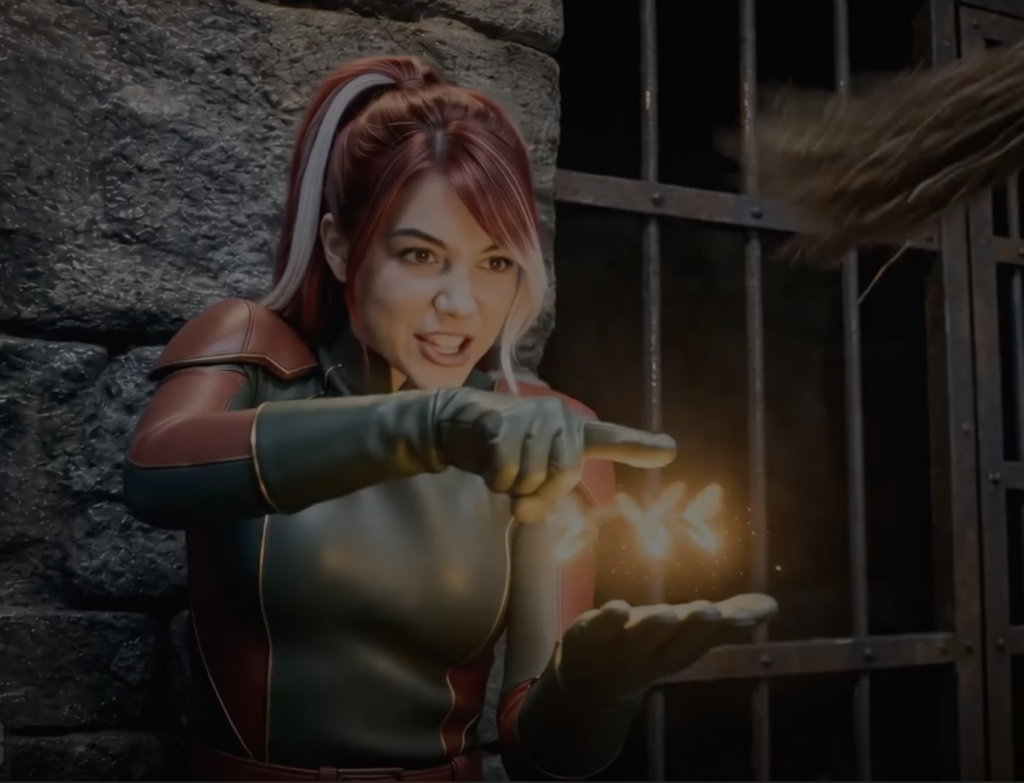
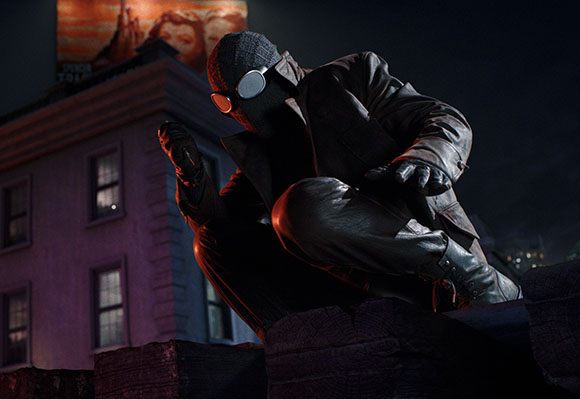
Prime Video’s Spider-Noir is set in 1930s New York City, where down-on-his-luck private investigator Ben Reilly (Nicholas Cage) is grappling with the loss of his fiancé and a past life as the city’s only superhero. New York is facing a crime wave, political unrest and the emergence of new genetically-altered villains, causing Ben to reevaluate his current path and responsibilities to the city.
Spider-Noir spans eight episodes and began streaming globally on Prime Video May 27th. The show makes extensive use of visual effects, with VFX producer Brooke Noska and VFX supervisor Hnedel Maximore leading a multi-vendor team – most of which are based in California.
“There’s a baseline budget,” Noska says of the show’s complex VFX needs. “Everything is kind of flexible, within reason. We have estimates of: This is what this episode requires. This is what we’ve allocated based on conversations with the different department heads…So we know kind of what the levels and estimates are, and we just make sure that we kind of stay within that bubble.”
Hnedel Maximore is an independent visual effects supervisor who has worked with Noska in the past, and was hired by Amazon and Sony to be the visual effects creative lead this project.
“I work closely with the directors, the showrunner, the DP on the creative briefs,” he explains. “I help design visual effects shots. I help to design visual effect with our showrunners, and I’m the creative lead that’s guiding, giving notes to the studios when shots come in. I’m helping creatively manage our in-house teams, and then working closely with our showrunner in post, and the showrunners and editorial on what’s possible.”
The series explored the option of using a virtual production volume to create in-camera effects, but opted to go a more traditional route, shooting against blue screens and compositing elements in post.
“I believe there was an exploration to do some virtual production,” says Maximore. “This was before I got involved on the project. Our showrunners decided that that wasn’t a good fit…I think they – our showrunners – wanted some flexibility in post that virtual production would have limited and would have led to a lot of shots being redone had they fully committed to the virtual production pipeline.”
Vendors were cast based on their talent, expertise and ability to handle complex shots.
“We knew that any one of our hero effects – anything surrounding noir and swinging through the city, multiple super characters, noir against a super villain – is a complex shot,” explains Maximore. “Not just from creative complexity, but also logistic complexity. There’s a lot of render time. You need to be partnered with a studio that has the infrastructure to handle those shots within our timeline.”
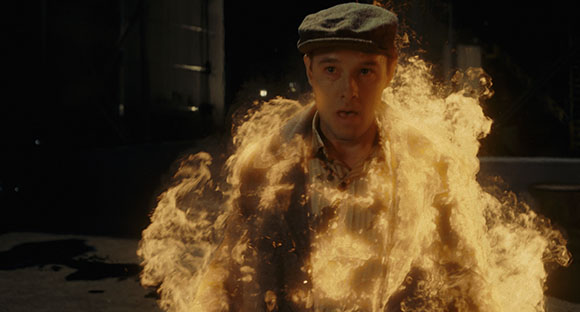
ILM was tapped for the series’ bigger sequences. Scanline handled Lonnie Lincoln and his Tombstone identity, in which his skin hardens into a shell-like material.
“Barnstorm did an amazing job with all of our set extensions and just kind of world-building environments,” says Maximore. “And they also did some overflow work with Dirk and Megawatt when we got hit with a schedule crunch and had to split off some work from ILM.”
Ingenuity Studios also handled environment work. And for the de-aging work in Episodes 5 and 6, Cosa VFX stepped up, drawing on past work with star and executive producer Nicholas Cage.
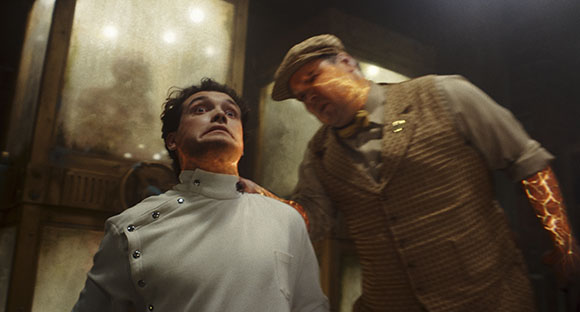
“Cosa does amazing de-aging work and beauty work, but they had also done The Unbearably Weight of Massive Talent,” Maximore shares. “It’s a Nick Cage movie where he plays against a younger version of himself, and Cosa did amazing work on that.”
Montreal’s Cinesite took on all of the creature work and some of the specialty one-off effects.
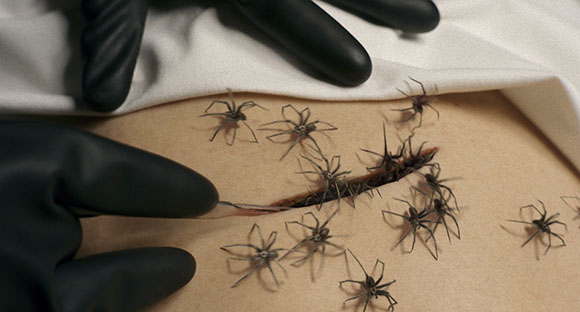
“They did an amazing job on the dream sequence,” notes Maximore. “They did an amazing with all the spiders that you see walking throughout the sequence. They did the sequence with Ben…where he doesn’t want to swing up to the fire escape, but he climbs up the fire escape. They took care of that.”
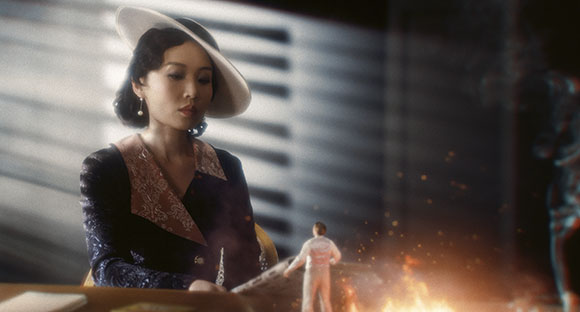
“Nick Cage was an amazing partner, and we were able to talk human to human with him about the use (of VFX) and what was going on,” adds Noska. “With the dream sequence, it was written a certain way, but it wasn’t really working. It wasn’t embodying the aesthetic of the project. So we made some pitches. It got pitched back to him. He was like, ‘I love it.’ We shot him on a treadmill – very noir, tactical, analog, like he’s doing it. We’re like, ‘How can we integrate that?’ Because again, we want to keep the human in the performance. So, Hnedel came up with an amazing pitch that absolutely ties seamlessly into the season.”
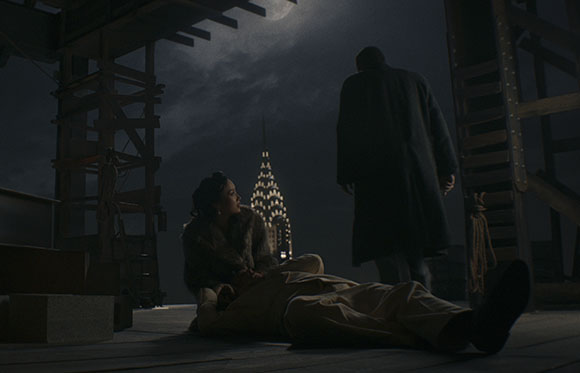
Maximore points to a number of visual effects highlights across the show, including those that first appear in the pilot, where Ben and Flint are fighting atop Rockefeller Center.
“Building out New York and establishing our world was a huge lift,” he reveals.
Episode 102 – “Convoy” – also stands out, as the entire sequence was shot on just two blocks in Los Angeles, but appears much longer in scale.
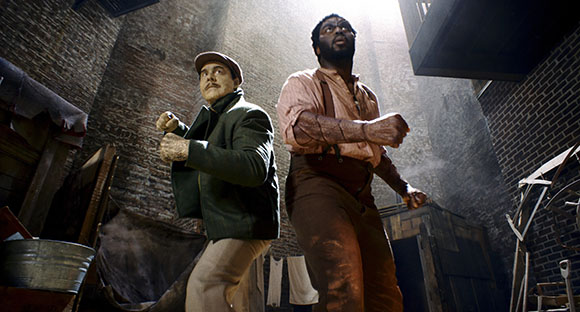
“You would not believe that we shot on two blocks in LA,” says Maximore. “Across a few days, and we had to plan everything down to a T, because we knew that there’s going to be X amount of set extensions when we’re traveling in this direction. We need to match light direction. And when we change, and when the sun changes in the afternoon, and we flip the world when we were filming, we absolutely cannot break continuity in the course of the sequence. So we made two blocks feel like 10 blocks of gravel. Then the car flips and they sit in one spot, and we redress that set too. I think that was a huge technical accomplishment.”
The Episode 8, the season finale, also stands out.
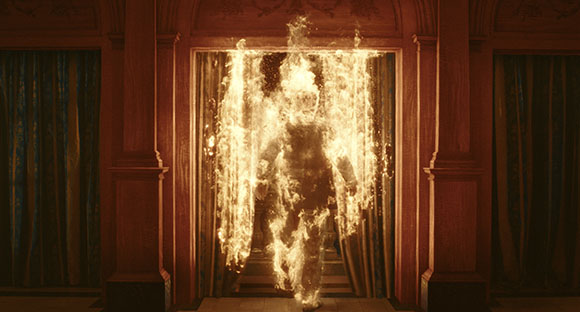
“We have three of our [superheroes], and they’re full powered the entire time,” Maximore. “And it’s a lot of fun.”
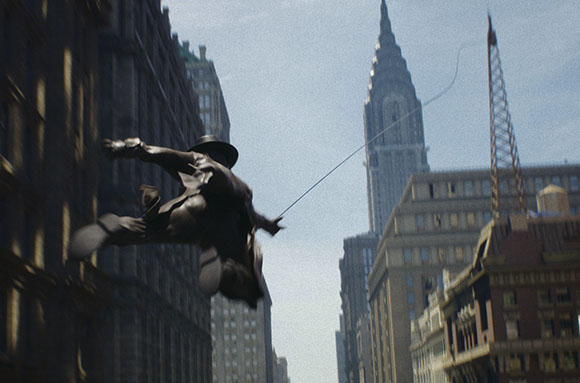
Noska points to the series open, in which the entire feel of the show, its character and time period are established, with Ben swinging though a black & white New York City as narration sets up the story.
“We put that back into the brain tank so many times,” says Noska. “We were like, ‘How are we going to open our Spider show? And there were so many different versions.”
“Our show always had this apprehension of, ‘I don’t know if I really want to start this show off on a big Spider moment,’” notes Maximore. “And the note from the studio kept coming back, ‘We want to start off on a big Spider moment. So we knew this was something we were going to have to deal with in post…Once our showrunner committed, and we worked on boards with him, and we got into the animation of it…I think by version three, the excitement immediately changed. Everybody bought in. It was good. Now we knew that we just had to execute.”