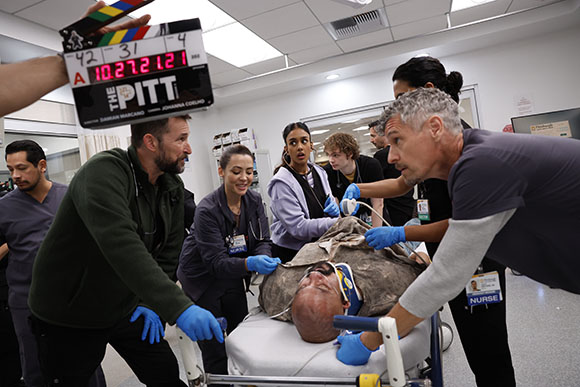
HBO’s The Pitt is a realistic examination of the challenges facing healthcare workers in today’s America, as seen from the perspective of the heroes working in a Pittsburgh hospital. The show stars Noah Wyle (Dr. Michael “Robby” Robinavitch), Patrick Ball (Dr. Langdon), Katherine LaNasa (Dana Evans), Supriya Ganesh (Dr. Mohan), Fiona Dourif (Dr. McKay), Taylor Dearden (Dr. King), Isa Briones (Dr. Santos), Gerran Howell (Whitaker), Shabana Azeez (Javadi) and Sepideh Moafi (Dr. Al-Hashimi).
Season 1 premiered January 2025 and won five Emmys, including those for Outstanding Drama Series, Lead Actor, Supporting Actress, Guest Actor and Outstanding Casting. Season 2 was released on January 8th of this year, and takes place over a 4th of July weekend.
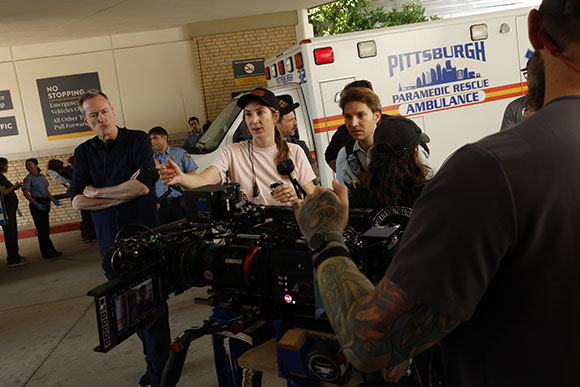
Johanna Coelho led the team of camera operators, working on both seasons. Her team perfected the style of the show while also raising the bar by pulling off long one shots with elaborate choreography. In addition to operating two cameras with different lenses simultaneously, she also implemented an elaborate system with two A-camera operators and coordinated a bootcamp for the new operator to make sure all shots were executed perfectly. Here, she shares insight into the show’s production.
Johanna, can you talk about the show’s visual language and the look you are going for?
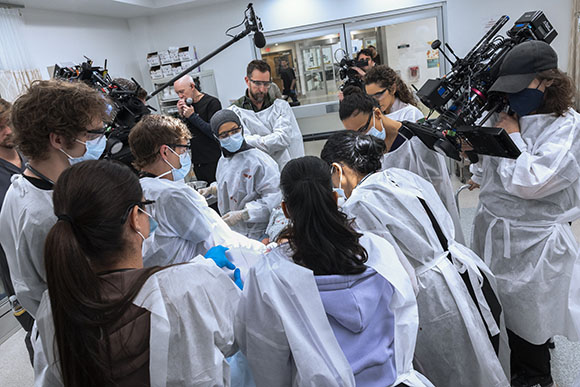
“It was important to transmit the sense of urgency visually and find a way to make the audience experience the shift with the doctors and nurses. I wanted the camera to be immersive, in the middle of it all, so we could get that feeling. The camera is physically close to the actors, which makes it intimate and emphasizes the immersive feeling: we see what the characters see and when they see it. For each scene, we decide whose perspective it is and create the shots around this decision. The camera follows and leads that character in a perfect choreography, which helps make it seamless, capturing as many story elements as possible. We then do pickup shots for some elements we couldn’t integrate in the long takes.
“In addition, we wanted a very realistic look. Therefore, the ER looks like a real one, with its white walls and bright overhead lights. The white balance is exact with the environment, which makes everyone’s skin tones extremely accurate. We were aiming for that perfect balance of cinematic and realism, with a bit of a documentary approach using handheld.”
How did things evolve in Season 2?
“We felt the approach was right on Season 1, but we wanted to elevate it a bit on Season 2 and make adjustments to help us on-set. Tony D’Amore, our colorist, created a new LUT that made the skin tones even richer and more real, while keeping a perfect white balance and reinforcing a bit of the contrast. This new LUT and his final coloring really helped elevate the show.
“We also made a few lighting adjustments on our set to make things easier when filming. We needed more light and color control in some areas. For example, the small nurses’ station in the North area lacked some exposure when characters had a scene in there, so we added extra cans in the station’s ceiling. We also improved our customized camera onboard lights, changing their shape and their brightness output. The new round shape helps a nicer round eyelight in the eyes and also looks more like a possible ceiling can if caught in a reflection.
“Finally, we hired an additional operator to alternate scenes with our A-camera operator, which really helped both of them getting rest during our fast shooting pace. Because the look of the show is so precise and particular, we made sure to train our new operator to adapt to our curated style.”
What camera and lens choices are you using, and did it remain the same from the first season?
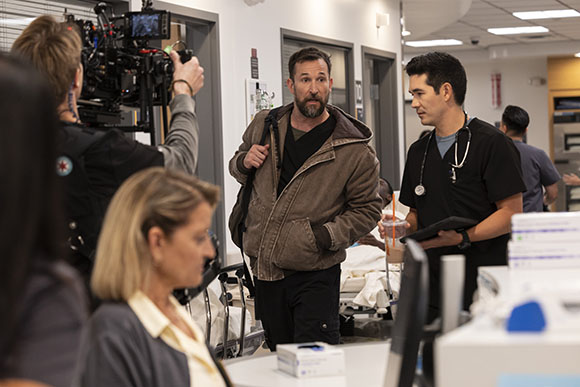
“We decided to keep the same camera and lenses for Season 1 and Season 2. We are using the Arri Alexa Mini LF, which allows the camera to get closer to the actors with the large format, as well as staying compact. Its latitude also helps us keep control of the many highlights in-frame, often from the troffers on the ceilings.
“We chose the Angenieux Optimo Primes for our A camera, and the Angenieux Optimo Ultra Compact zoom (37-102mm) for our B camera. The choice of primes for our main camera was to keep our visual language precise by using only a few optics, each for specific situations (50mm, 60mm, 75mm). The B camera is on a zoom to help its purpose: to come and grab specific shots and moments during a full choreography shot by the A camera. I needed this camera to be able to resize during the take to grab multiple shots if needed, while sticking to our visual language of primes. And with the range of the 37-102mm zoom, it carries all the specific focals we use.
“The Optimo Primes and Ultra Compact Zoom are a very close match, which really helps us match the cameras together as much as possible, and this was a key point. Both are also extremely lightweight for cinema lenses and zooms, which was another important feature for our full handheld show.
“Last but not least, I was looking for a realistic look yet cinematic, and these Angenieux really bring a beautiful mix of that. They allow details while keeping a certain softness on the skin. They also read really beautifully on every kind of skin tone. I use them without any filtration.
“To allow a fast and precise camera movement on our long choreographed shots, while still feeling handheld, but without being too intense, we use our A camera on a ZeeGee rig.”
The show has a number of 360 shots. What were some of the challenges in shooting those sequences?
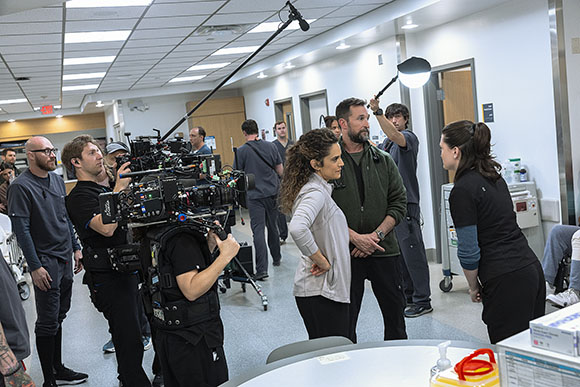
“There’s a real beauty and uniqueness in being able to move the camera in every single direction when you shoot narrative, but it definitely comes with challenges. Moving the camera 360 means that nothing is ever safe on-set: whatever is not part of the frame needs to be moving with the camera. This creates a higher level of coordination between the crew, the actors and the background. The space behind the camera is very limited and needs to be shared and synced by all the key people needed during the shot: the camera operator, the spotting grip, the boom operator, sometimes an electrician with a light on a pole, and sometimes the on-set photographer as well.
“We are also shooting on a set full of glass doors and windows – creating a beautiful depth – which means we have to be very mindful of reflections. The windows on our set gimbal, which helps us a lot, but with a lot of people moving behind the camera it still gets very challenging. This is why the crew wears scrubs on set. If they get caught by accident in a reflection (without gear), it looks like it was just a background person.
“On that note, because it’s a 360 set, the background is everywhere. To make the environment feel real, the outstanding AD team choreographs crosses in front of the camera, which adds another level of challenge for timing of the movement. Sometimes, the space is too limited for everyone to get in a corner, and we’ve had to move furniture during the shot (like gurneys or rolling carts) out for a few seconds when out of frame, and then back in when the camera would turn again.
“Lighting-wise, the 360 shot challenge is making sure your environment is lit for every direction and whatever else might be needed for the faces has to move with the camera. In our case, we have two fully-customized onboard lights on the mattebox (left and right side), as well as a Dot Dash light on a pole.”
Does the show’s practical FX affect the way you shoot?
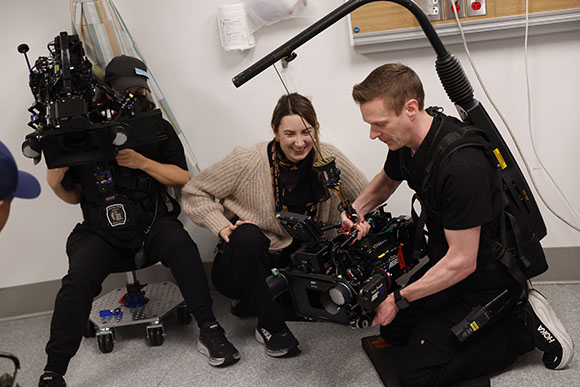
“The prosthetic work and practical FX on the show are truly amazing, and they are a big part of every episode. We are working closely with the practical FX’s team to make sure we give them the space they need for their FX, while still getting the camera as close as possible and in the right place to get the best perspective of the shot. The SFX team and their tools are often right next to or below the camera.
“Regarding the prosthetic work, we work closely with the makeup team to understand the features and limitations of the prosthetic: sometimes we aim to shoot the prosthetic closely first as it might get damaged as we do multiple takes and resets, and sometimes we shoot it last because the actors might need more training on them and we let them get comfortable with it by filming their faces only first. Each scene involves its own challenges, and we approach them differently depending on the prosthetic and practical effects involved.
“For example, in Episode 201, the open chest surgery required multiple considerations between prosthetic and SFX. The prosthetic built was a full chest with all the internal organs, and when it gets fully opened up, the heart is beating. This is achieved by the [special effects] team, in addition to the blood spilling out. The prosthetic was pretty solid on this one, but the lung rotating was pretty fragile, so we made sure to shoot the scene in a way we wouldn’t have to flip the lung too often so we wouldn’t damage the prosthetic. We also placed the cameras in a way we wouldn’t see the SFX tubes pumping the heart and the blood. This collaboration between departments really helps the scene feel real and filming it on set was impressive to watch.”
Is there a scene or sequence that you would point to as a highlight this season because of the challenges, look,or action?
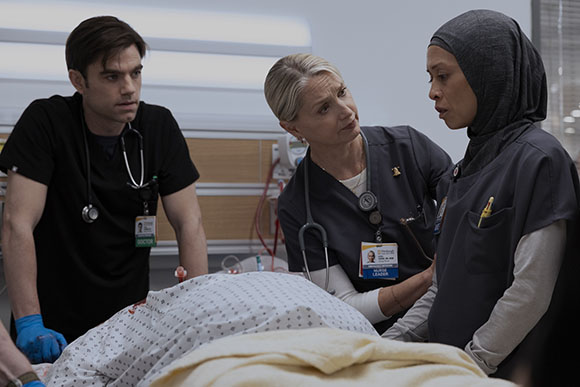
“I think there is a uniqueness in Episode 206 by using more the perspective of the nurses. This episode had a lot of emotion and a certain unity between all the characters.
“We really aimed to elevate the feelings of the nurses, like the scene where Louis dies. In the middle of all the action, we see shots of nurse Dana, Emma and Perlah’s reactions. You see them through people moving in the foreground doing their job. Sometimes the camera just gets close to them entirely, and you understand how much they get affected.
“The nurses also lead the story in this episode. They grab us from one scene to another in a seamless transition, like when Perlah leaves Louis’ room disturbed, and locks eyes with Princess across in another room.
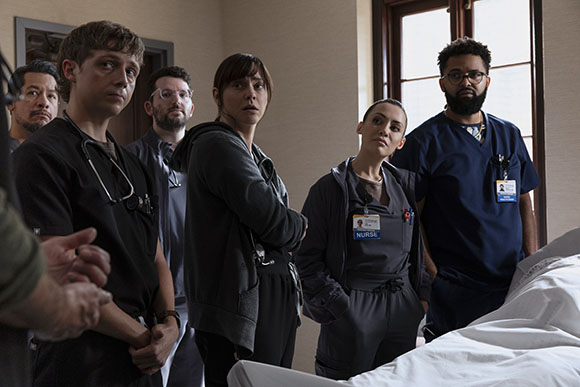
“The final scene, when the staff pay their respect to Louis, was very important and different. We are not in the bright ER anymore, we are part of a more secluded room where all of our characters are gathered together. We wanted the light to feel more intimate with a stronger contrast and mood, feeling a little bit more of the outside world with the sun through the windows. The frames are often shared with multiple people elevating the feeling of community, and the moves are slow and smooth. There’s a certain calmness to this scene, providing a pause in the intensity of their shift.”