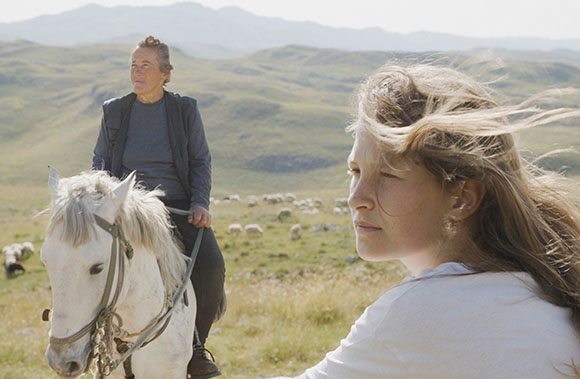
The documentary To Hold a Mountain is set in the remote highlands of Montenegro, where a shepherd mother and daughter defend their ancestral mountain from the threat of becoming a NATO military training ground.
The documentary was directed by Biljana Tutorov and Petar Glomazic, who invited cinematographer Eva Kraljević to collaborate after seeing her 2015 documentary, I Like That Super Most the Best, which explores her relationship with her sister with Down Syndrome.
“Also, they knew they wanted a woman DP because of our main women protagonists, Gara and Nada,” Kraljević adds. “We clicked extremely well and quick, among ourselves as a team, and with the family we were filming. As we became very close, this just transferred to my camera work – it allowed me to be intuitive and free.”
Kraljević describes her cinematography for this latest project as tactile and intimate, while also giving the viewer space to feel and to think.
“It provides both the distance and the closeness,” she shares. “We were very cautious not to film postcard-like landscape shots, as we didn’t want to exoticize the community or the landscape. I initially shot with my own Canon C300 Mark II kit, and by the second year we incorporated the C70. It was lighter, performed exceptionally well in low light, had great autofocus and paired easily with the C300. I used it mainly for more dynamic, handheld scenes, and on a gimbal. I’m really happy with the result in that regard and the balance we achieved.”
Kraljević calls attention to the film’s editor George Cragg, who brought the best out of the many hours of footage while honoring the protagonists and the mountain.
“The scene I’m most proud of is the scene where Gara and Nada are searching for the missing cow in the fog,” Kraljević shares. “It was a physically extremely demanding task – running up and down, climbing the steep rocky terrain with the camera – not knowing exactly what would happen, while focusing on maintaining a connection with the two of them. Through this scene, the cow, Flora, becomes a true character in the film, and we clearly sense that she understands what is happening, whom she trusts, and whom she does not. So much happens in that scene. It’s a deeply-emotional moment. This scene plays a pivotal role in the story and could stand as a short film on its own. I’m pleased I had the endurance to pursue it from the beginning to the end – three hours of continuous filming – which allowed me to capture this very powerful scene about motherhood.”