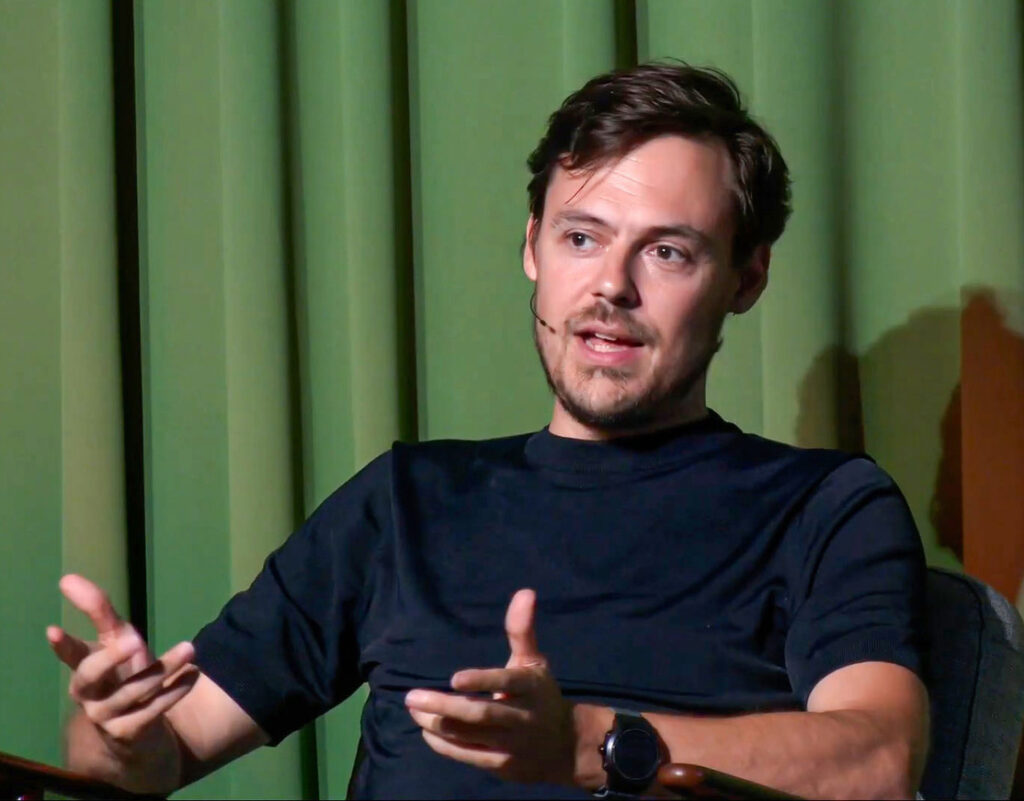
Jo Plaete is the CTO of Brahma AI (www.brahma.io), an enterprise AI content platform that combines Hollywood-grade content technology with enterprise-scale AI innovation. Brahma AI transforms raw data into dynamic video, audio and immersive experiences through purpose-built AI agents. From ATMAN and photoreal digital humans to VAANI voice synthesization and multilingual and lip-synced localization, the company enables enterprises to create authentic stories that resonate globally.
Here, Jo lends insight into the company’s work, which was recently honored with a Technology & Engineering Emmy.
Why was Brahma AI honored with a Technology & Engineering Emmy?
“Because the technology moved from research into something productions could rely on. The category is AI-based face replacement and performance-preserving transformation, and the committee’s question is material impact. Ours was Here: 60 minutes of 4K de-ageing and ageing, run live, on-set for four months without dropping a processed frame, on a film that could not have been made the traditional way.
“Before that, three live episodes of America’s Got Talent in 2022, the first AI finalist in that show’s history. Then the VMAs, Drake’s tour, Furiosa, Alien: Romulus, a VES award, a SIGGRAPH paper and three granted patents. The Emmy recognizes that whole arc, not one trick.”
What is Neural Performance technology and why does it matter in filmmaking?
“It’s a way of capturing and transforming a human performance without rebuilding it. Traditional digital humans go through scan, rig, track, animate, simulate, render, composite. Every stage reinterprets what the actor did, and fidelity leaks out at each handoff, in the most perceptually sensitive region there is.
“Neural Performance starts from reality. It works from the principal camera, solves the full facial performance as a dense neural representation, separates it from identity, and synthesizes the new face in one step. The photographed performance stays the source of truth. It matters because it collapses the gap between shooting and seeing. Zemeckis directed the characters he was actually going to get. That changes who makes decisions on the day, and it changes which films are possible.”
How do you see this impacting the industry in the next three to five years?
“Identity used to be something you rendered. Now it’s something you license. For 30 years, digital humans were a VFX problem. They’re becoming an identity problem: who owns the face, who trained the model, who controls the output. That reshapes talent deals, estates, localization and distribution. On-set, real-time will become the default. You won’t accept guessing when you can see the result. Localization will stop meaning subtitles and dubbing.
“Ramayana is the first large film to release in a second language with the original performances intact, and it won’t be the last. And the tools will commoditize. You won’t need a $150 million dollars to do something complex, which opens high-end work to many more filmmakers. With that comes noise. Quality still prevails.”
How does Brahma’s approach compare to the fellow recipients, Disney Research, RSP and DD?
“They’re excellent, and we’ve all been working the same problem from different angles. FRAN, at Disney Research, is a strong image-to-image re-ageing system. REVIZE and Charlatan are proprietary toolsets inside two of the best VFX houses in the world. The difference with us is the realtime axis and breadth of deployment. We run from the principal camera or a live broadcast feed – no markers, no head rig – and return the transformed performance to the director in six frames or to a broadcast truck in under 200 milliseconds. We’ve proven it at long-form scale on film and at arena scale on tour, and we’ve kept the artist in control through Neural Animation. And we’ve since taken it beyond VFX into a platform. Same category, different bet on where it goes.”
How is Brahma AI currently being used in production?
“In film, through our own team and as a managed service through Dneg, on titles including Here, Furiosa, Alien: Romulus, F1, Happy Gilmore 2 and Karate Kid: Legends, with more in progress. In live performance, from the VMAs to Drake’s 88-show run. In localization, where the Ramayana trailer presents the Hindi performance in English with the actor’s own voice and lip sync. Those are the deployments the Emmy recognizes, and they’re still where we push the technology hardest. The same stack is increasingly used outside entertainment, by broadcasters making archives searchable and by organizations creating consented digital humans for communication and training. Fewer larger relationships by choice.”
How can filmmakers harness AI while preserving creative control?
“Insist on controllability. The problem with early neural tools was the black box. You put something in, something came out, and if it wasn’t what you wanted, you were out of luck. Directors don’t work like that. On Here, most of Bob’s notes were eye lines, because these networks love to look down the barrel. We built Neural Animation so an artist could steer gaze, expression intensity, age, likeness, region by region, without losing the actor’s performance underneath. Second, see it early. Realtime on-set means the DP, hair & makeup and the actors are all part of the loop. Third, own the data. Licensed footage, actor consent, models deleted after the show. Control isn’t a feature you ask for afterwards. It has to be in the architecture.”
What’s next for Brahma AI?
“Keep pushing at the high end, because that’s where the technology gets proven. Full-body and environment models on top of the face work. Lower latency and higher resolution on the live systems. VAANI for realtime multilingual performance, so a Ramayana-style release becomes routine. And the provenance layer that makes all of it trustworthy. In parallel, the $150M raise lets us scale what we proved in film into a platform: a Silicon Valley presence, a research center in India and the best people we can find. The end state isn’t a face swap. It’s a full digital human you can license, direct and generate against, built to a film standard. And, obviously, a much better version of my own.”