Unless you started in this industry in just the last 10 to 15 years, there’s a 99.9 percent chance you’ve worked with one of the dozens of video and audio tape formats that have come and gone over the years. This year marks the 70th birthday of the first videotape, Ampex’s two-inch Quadruplex, which debuted at the 1956 NAB show and dominated broadcasting for two decades until one-inch “Type C” arrived in 1976.
In 1971, Sony introduced the U-matic 3/4-inch cassette, the first successful “video cassette” format. Originally aimed at consumers, it was too expensive for them and instead found homes at small TV stations, corporations and schools. In 1973 Sony released the smaller shell for U-matic “S” tapes and built the first truly portable VCRs, freeing news crews from developing and transferring 16mm film before editing and air.
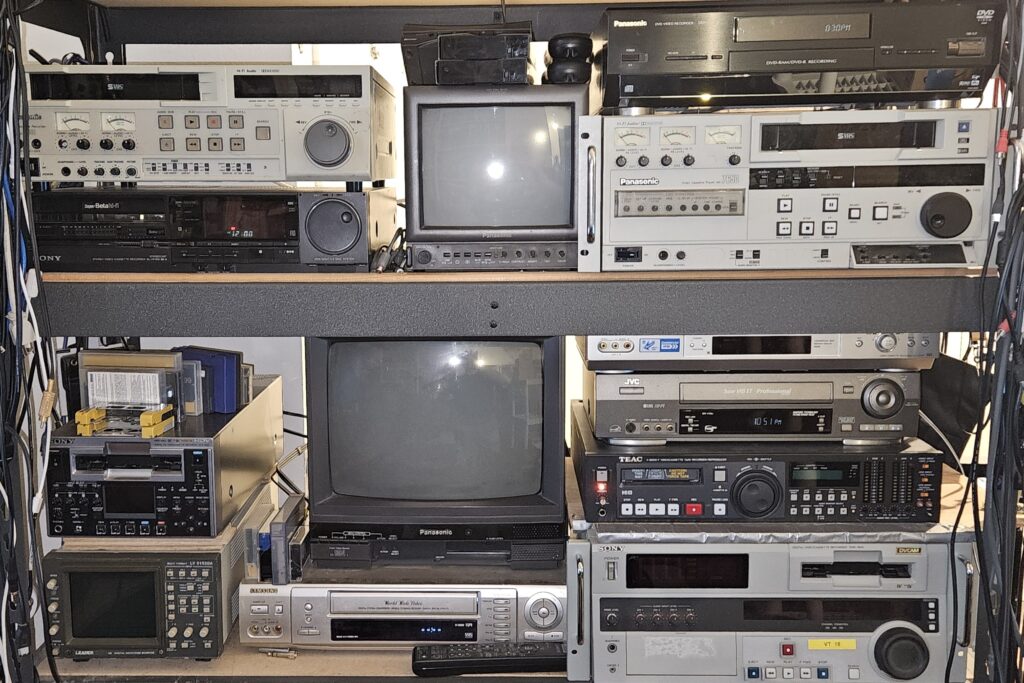
On the home front, 1/2-inch open-reel, black & white decks (some with color adapters) were out in the 1960s, but home video really took off in 1976, when Sony’s Betamax beat JVC’s VHS to market by a few months. I won’t rehash the format wars. Sony later ran Betamax cassettes at 6x normal speed for the original Betacam, recording component video and creating the first true pro “camcorder” — a camera and VCR in one unit. That same cassette shell carried through Beta SP, Digital Betacam, IMX, Beta SX, HDCAM and HDCAM SR.
As consumer gear improved, Panasonic and JVC built broadcast versions of S-VHS, and Sony did the same for Hi-8, letting young people buy a camcorder and a couple of decks to edit. At CSUN, everyone seemed to run a side company shooting weddings and bar-mitzvahs on weekends (it paid for my college). This is while the school only supplied a single VHS edit system for TV, and a Hi-8 system for film majors.
In 1990 and 91, I interned at America’s Funniest Home Videos. This introduced me to Betacam SP, U-matic SP, D-1, and D-2. Home-video submissions were transferred to U-matic SP or Betacam SP for playback during the live taping, which recorded to D-2.
The 1990s brought a wave of digital formats built on consumer DV. DVCAM and DVCPRO survived, Digital-S and Micro MV didn’t. I started my own company on S-VHS in 1991, added a Panasonic DVCPRO deck in 1997, a Digital8 camcorder in 1999 and a Sony DVCAM deck in 2000. When everyone started dumping analog VTRs in the 2000s, I started collecting: a U-matic, U-matic SP and 2x Beta SPs for $100 total. Additionally decks were being given away or traded for consulting.
My cameras evolved from Pro S-VHS to Panasonic’s Pro DV camcorder to Sony’s FX1 HDV, and finally to Sony’s HVR-S290 and HVR-Z7U, which I helped design (including a hybrid tape/flash backup system). Then came 2020.
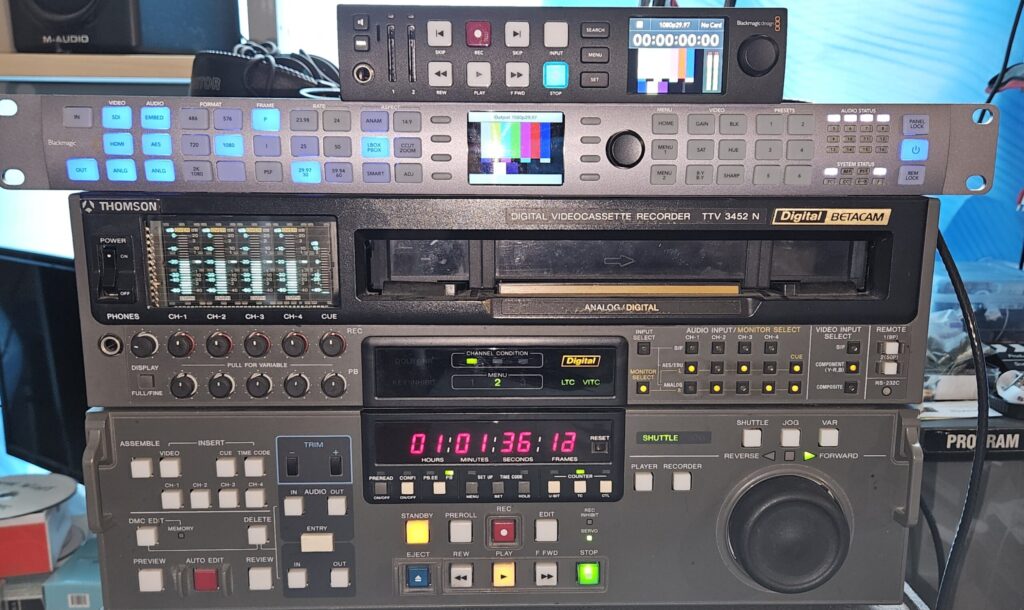
The pandemic gutted production, so I looked at my shelf of decks and re-geared as a transfer company, advertising locally. Living near LA’s industry crowd, I got calls asking, “Do you know what Betacam and U-matic are?” Soon I had a steady stream of clients digitizing home videos and old work tapes, mostly to H.264/MP4 for sharing with family. I started with Matrox capture hardware until Matrox discontinued support for it. I went to Blackmagic Design’s H.264 Pro Recorder and Video Assist for ProRes/Avid codecs, and now use a HyperDeck Studio HD Plus, which adds 4K.
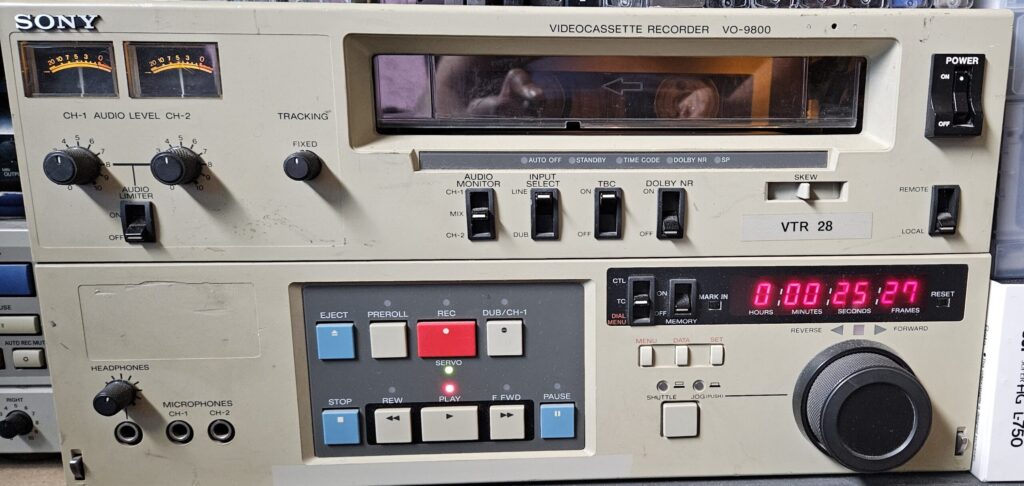
For professional transfers, U-matic and Betacam SP are the most requested. A couple years ago, Paul McCartney’s post production team brought me tapes for his documentary Man on the Run. For U-matic, I ran the composite signal through a 1990s DPS TBC-4, housed in a Commodore Amiga, which converted it to Y/C component, then to SDI, upscaled to 1080p via a Teranex and recorded to ProRes 422. For Betacam SP, a Sony DVW-A500 Digital Betacam deck with analog playback and a built-in TBC simplified the process. Sir Paul’s team loved the “nice film look.”
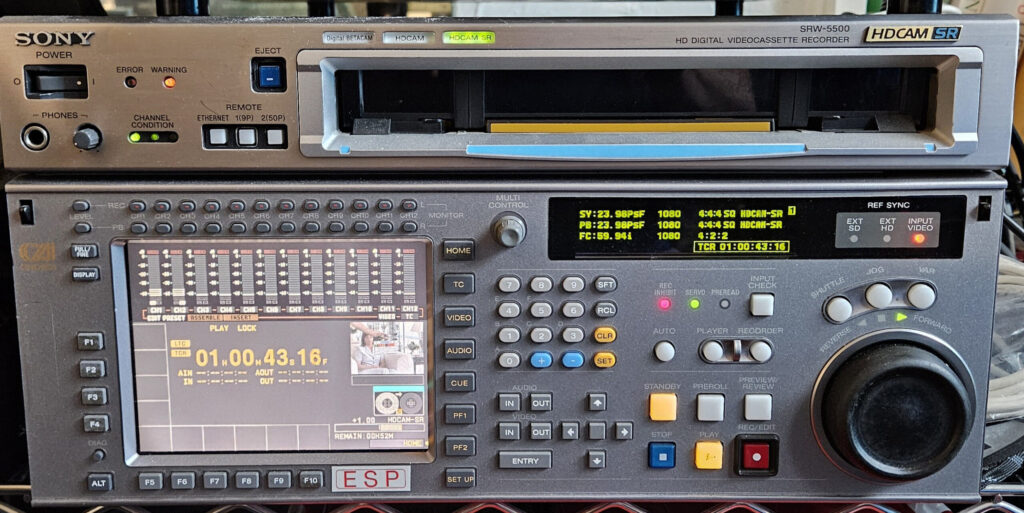
So far in 2026, PAL tapes make up about 30 percent of our transfers. This is handled on PAL-specific decks, like DVW-A500P for Digital Betacam and Beta SP, and multi-system, multi-format decks. My prized deck is a Sony SRW-5500 HDCAM SR, fully optioned with Digital Betacam playback and built-in up/down scaling. It sold for $125,000 in 2012 and is easily the most complex VCR I’ve used, requiring a cheat sheet to navigate six menu layers for playback settings. The most unusual tool in my shop isn’t video gear. It’s a food dehydrator. Tapes from Ampex (and its later Quantegy rebrand) suffer “sticky shed syndrome.” Baking them at 130- to 140-degrees Fahrenheit for a few hours loosens them enough to play. Sony’s Hi-8/Video8 metal-particle tapes from roughly 1989 to 1993 are worse. After baking, they’ll only play four to 20 minutes before residue clogs the heads, forcing capture in segments. I’m hopeful new tape-cleaning products will fix that.
In looking for a transfer service, most are running poor-condition, consumer VCRs that were obtained through Craigslist or Ebay, without a TBC, waveform monitor or vector scope, and a $20 cheap MPEG encoder. Surprisingly, some industry people use them, even though consumers can see the difference.
Marc Franklin is a Producer/Creative Consultant at Franklin Creative Media (www.FranklinCreativeMedia.com).