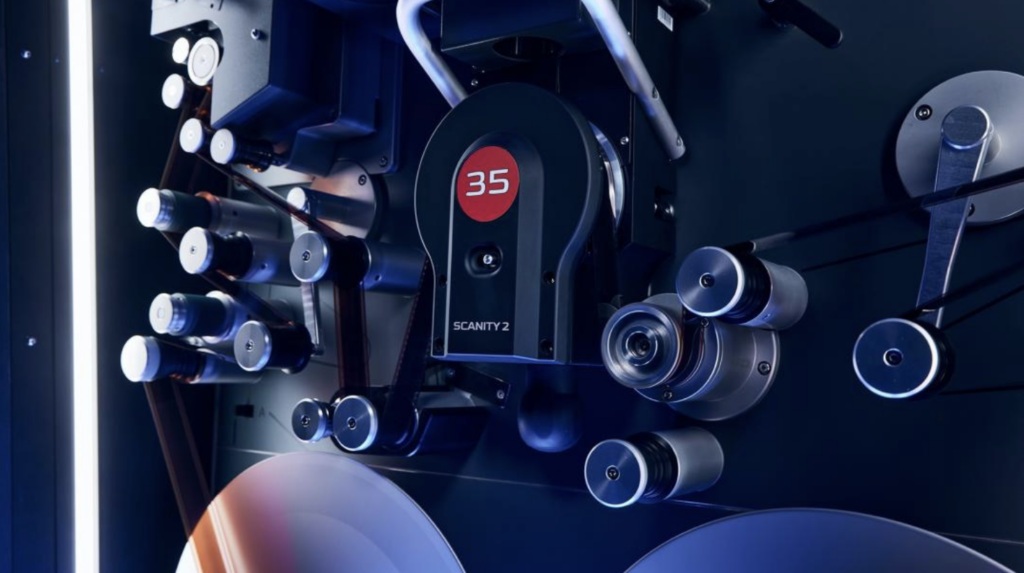

Data storage is a key element in modern content creation, editing, distribution and reception. Data capacity and communication speed increases while form factors change. The growing familiarity with digital editing, digital intermediates and various forms of digital distribution are key components in the continued growth and development of entertainment.
However, in 2025 and 2026, the prices of all digital storage and memory technology increased due to the massive build out of data centers for AI training and inference. This led to significant increases in storage prices, which are changing the way digital storage is used. In particular, NAND flash, and thus solid-state drive (SSD) prices per TB, have increased considerably.
While hard disk drive (HDD) prices per TB have also increased, the difference in $/TB has increased to over 10x for SSDs versus HDDs from about 5x in early 2025. HDD and SSD vendors report that their production is contracted out into 2027 or later. As a consequence of these shortages, many M&E facilities are resorting to changes in their storage choices. For instance, using HDD rather than SSD storage, when possible.
At last April’s NAB show, LTO tape system vendors said that even though magnetic tape prices have also increased, customers were buying tape storage systems and moving data to tape to avoid paying higher prices for new HDD storage. Because of the large file sizes required for high-resolution and multi-camera images, there is increasing demand for high-capacity storage devices, as well as high-performance storage. The entire value chain of content creation, editing, archiving and distribution, as well as consumer electronics content reception devices, provides an accelerating, feed-forward mechanism.
In addition, the rising use of data analysis and various artificial intelligence (AI) technologies in the media & entertainment industry favors new mixes of various storage and memory technologies. These factors drive growth in data storage for all entertainment content applications.
There also has been a slowing of the growth in the use of storage resources in the cloud, with some repatriation of data from the cloud to local storage or private clouds for various reasons, including cost controls and controlling content access. For many archiving and distribution applications, where content is relatively static, low-cost/high-capacity HDD storage, optical discs and magnetic tape-based storage libraries will dominate, with some flash memory used for caching and metadata.
Note that many active archive systems may also be hard disk drive-based and will often include magnetic tape and use SSDs for caching. Hard disk drives, as well as SSDs, are also used in some high-performance storage applications, where storage cost factors must be balanced with performance requirements.
For applications requiring rugged field use or fast playback response, flash memory either, as cards or solid-state drives, are now standard fare. Mobile applications and SSD caching are also starting to drive the use of various emerging, non-volatile memories.
From February through July of 2025, Coughlin Associates conducted a survey of professional media & entertainment professionals on various digital storage topics. The survey was broken down into several segments: content capture, editing & post production, and content delivery, as well as archiving and digital preservation. Results from that survey, as well as the 2026 Coughlin Associates report on Media & Entertainment Storage, will be used to provide some illustrations in this article.
Content creation & acquisition
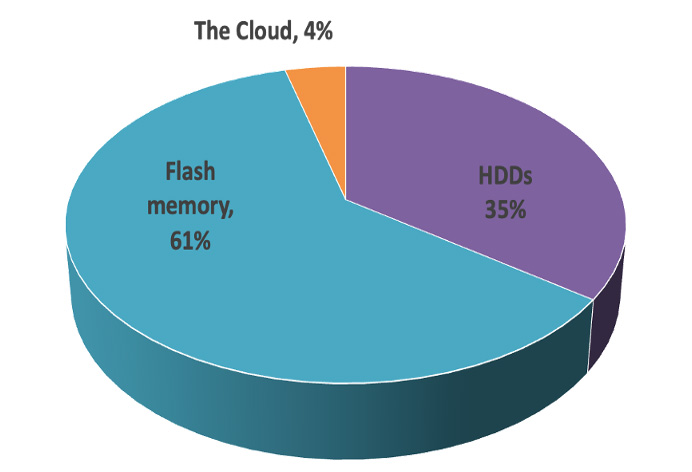
Figure 1 shows the percentage of various recording media used by the 2025 survey participants in professional video cameras. Flash memory and HDDs dominated the responses. Nobody reported using film, optical discs or magnetic tape in video cameras. About four percent was recorded directly to the cloud.
We also note that in the survey, while 66 percent reported capturing two to five hours for an hour of completed video, 34 percent captured six to 50 hours of content for an hour of completed video.
AI is increasingly being used in video projects, as well as large screens, to avoid having to build sets or travel to locations for special shots. These technologies could reduce the time and costs for video production, enabling more creative content creation and perhaps higher employment in the industry.
Post production storage demand
Post storage demand is increasing with more multi-camera, 360-degree projects; higher resolutions; more bits-per-frame; and higher frame rates. This drives overall storage requirements, as shown in Figure 2. The chart shows a growth in cloud storage that will be larger than local network storage, but overall, more content remains local rather than in the cloud.
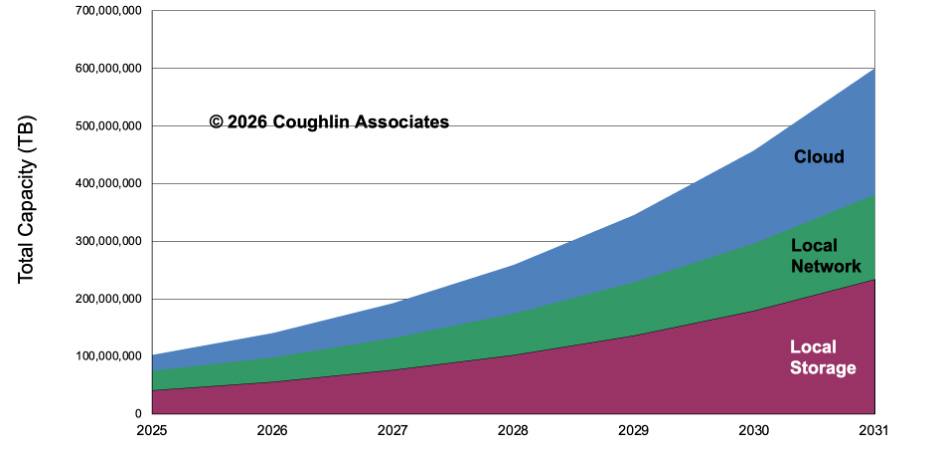
Demand for low latency local storage, particularly for smaller facilities, remains strong. Network storage will also experience growth, with an increasing amount of this storage being used in private clouds for remote access, as well as studio access. Growth is expected in private and public cloud storage to enable remote video collaboration projects and cloud-based editing.
The media & entertainment storage tiers
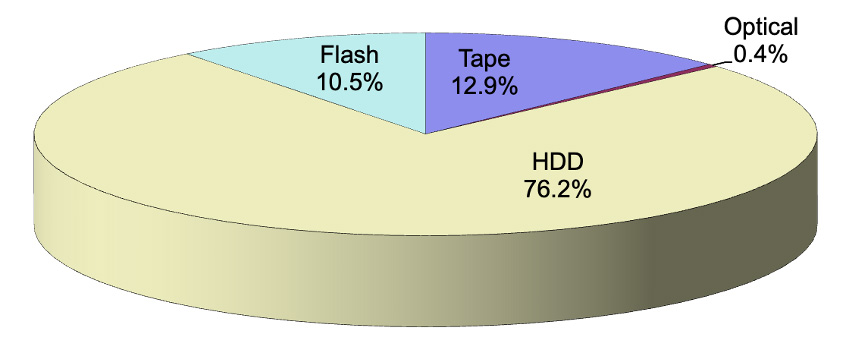
We will focus here on SSDs, HDDs and magnetic tape, although with the activities of several optical storage startups, optical storage could play an increasing role in archival storage by the end of the decade. The pie chart shows our estimates for 2025 of digital storage capacity used in the industry for HDDs, flash (SSDs) and magnetic tape.
SSDs
SSDs, especially with NVMe interfaces, are increasingly used as primary storage, where data currently being worked on is stored. NVMe SSDs are available from many companies, including Kioxia, Micron, Sandisk, Samsung, SK Hynix, Seagate and Western Digital. NVMe enabling technology is available from companies such as AMD, Huawei, Intel, Marvell and Nvidia. SSD storage capacities are now available with over 200TB capacities, using quad level cell (QLC) technology, although these will come at considerable cost and are best used in mostly read applications.
HDDs
With the introduction of Heat Assisted Magnetic Recording (HAMR), enterprise and data center HDDs with capacities over 30TB are now available, with 100TB HDDs likely by the end of the decade. HAMR and other HDD technologies will continue to drive down the costs of HDD storage, likely faster than those of SSDs, particularly with the high prices for SSDs due to the demand for AI applications.
Thus, HDDs should continue to dominate in secondary storage for media & entertainment applications where content is not in immediate use and where that content can be moved to SSD primary storage when needed.
Magnetic tape
Magnetic tape has a long history of use for archival storage, storing data that needs to be kept longer term but doesn’t require fast access times. Magnetic tape and optical discs have provided the lowest storage costs, and library systems built with these technologies consume the lowest energy since the data isn’t accessed until the media is put into a drive.
LTO tape dominates this industry, with current LTO-10 tape providing up to 40TBs of native capacity, and with projections for 100s of TBs of native capacity by the next decade. Magnetic tape is often advertised with 2.5x compression, and with the LTO tape roadmap, tape capacities close to a petabyte, compressed, could be available in the next 15 years.
Storage for archiving
Long-term storage of video content requires inexpensive content storage. However, today archived content is accessed more readily than older passive archives, often offline in cold storage facilities. For this reason, many archives are now “active archives” that provide lower latency archived content access. The ultimate storage for these active archives will be on magnetic tape (mostly LTO), optical discs and hard disk drives.
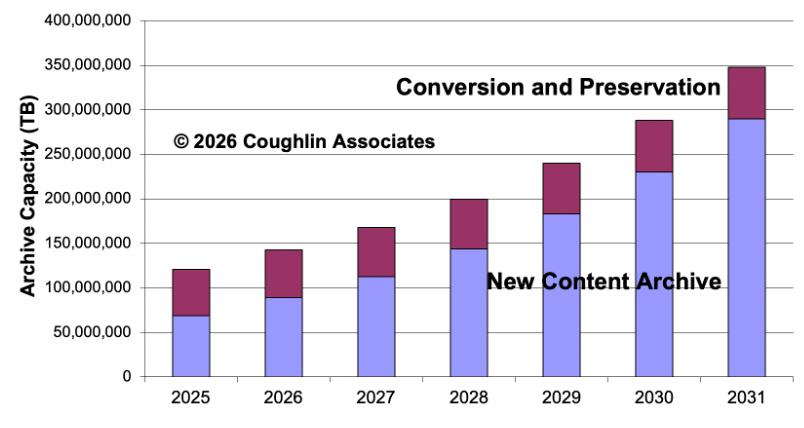
Although there is still a considerable amount of older video content that has not yet been digitized, much of the content that will be digitized has been or will be in the next few years. For this reason, future archive growth will be increasingly driven by archiving of new video content, as shown here in Figure 4.
Conclusions
Digital Storage feeds every aspect of modern media workflow. As professional video content size grows to support ever more immersive experiences, so have the requirements for performance, latency and storage capacity. Digital storage and memory vendors are creating new storage products to meet these needs so video professionals have the tools they need to express their visions.
The 2026 Report
“The 2026 Digital Storage for Media & Entertainment Report,” from Coughlin Associates, provides 195 pages of in-depth analysis of the role of digital storage in all aspects of professional media & entertainment. Projections are given out to 2031 for digital storage demand in content capture, post production, content distribution and content archiving, and are presented in 62 tables and 129 figures.
You can find out more about the report and order direct at: https://tomcoughlin.com/product/digital-storage-for-media-and-entertainment-report/.